




Email Marketing Statistics – 2011, 2nd Quarter – Bounce Rate, Open Rate, Click-through Rate, + by Niches
Hey guys,
Hope you’re doing great! I got more fresh statistics for you – Email Marketing 2011, Second quarter. See charts below – Bounce Rate, Open Rate, Click-through Rate, plus all this data by niches and businesses. Enjoy!
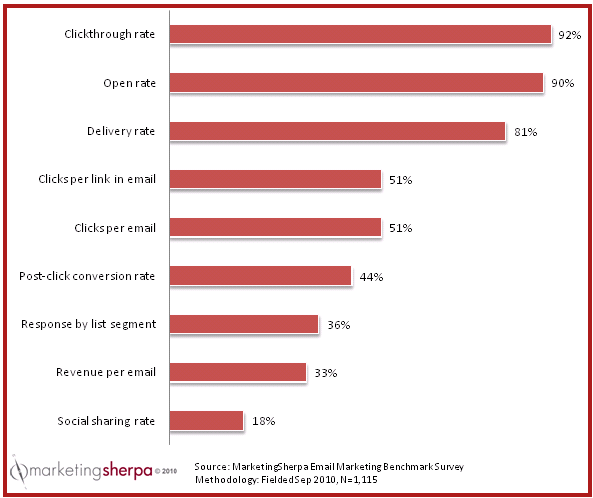
Email Marketing 2011 – Top 9 Metrics and 1 Trendy Trick
Hi friends,
Email Marketing is a great business with billions of revenue and investments. Email Marketing niche is changing as the time flies. Starting with 2009 we had to track and improve the social media part of Email Marketing. In 2010 we tested new HTML-emails, built-in social media widgets and built email lists using different social networks.
Now let’s talk about year 2011. This is a very special year for all of email marketers, because we have so many techniques and trends now we need to track, test, and improve!
Today we’ll talk about metrics. See below the chart for further information of what email marketers should concentrate on measuring in 2011.
Click to continue reading “Email Marketing 2011 – Top 9 Metrics and 1 Trendy Trick”
Email Marketing 2010 – Email Statistics Report – Forecast for 2010-2014
Hi friends,
Hope you’re doing really well. As we all know, email account is something constant for us nowadays, and it’s as personal and unique as your phone number. Email correspondance is the normal way for corporate information exchange. Here is a short excerpt from Email Statistics Report with a Forecast for 2010-2014. Hope you enjoy reading!
- The number of worldwide email accounts is projected to increase from over 2.9 billion in 2010, to over 3.8 billion by 2014.
- In 2010, 75% of all email accounts will belong to consumers, and 25% to corporate users. This ratio is expected to stay fairly constant over the next four years, with corporate email accounts growing slightly to about 26% of the total number of accounts by 2014.
- The majority of email accounts, today, are free or low-cost consumer ISP/Webmail accounts.
- The average number of email accounts per user ratio is expected to remain even at roughly 1.6 accounts per user over the next four years.
- Geographically, in 2010, the majority of email users are located in Asia/Pacific (47%). Europe accounts for about 23% of all users, North America has about 14%, and the Rest of the World has around 16% of all users.
- In 2010, the typical corporate user sends and receives about 110 messages daily. Roughly 18% of emails received is spam, comprising both actual spam and “graymail” (i.e. unwanted newsletters, alerts, etc.).
- While users mostly see spam as an annoyance, for corporations it is a considerable expense. According to our projections, a typical 1,000-user organization can spend upwards of $3.0 million a year to fight and manage spam.
- Instant Messaging (IM) is also growing in popularity with both corporate and consumer users, we estimate that there will be nearly 2.4 billion IM accounts worldwide in 2010, growing to just over 3.5 billion by 2014.
- Social Networking has seen explosive growth in the last 18 months and by year-end 2010 we expect to see nearly 2.2 billion social networking accounts worldwide comprising both consumer and business accounts. By 2014 this is expected to grow to nearly 3.7 billion accounts worldwide.
- Wireless email accounts including both enterprise and consumer accounts total about 307 million in 2010, and will grow rapidly over the next four years to 1.4 billion accounts worldwide.
Statistics 2010 – Email and Facebook Domination in Content Sharing
Hey guys,
Here are the latest Email Marketing and Social Media statistics on content sharing. Let the digits talk!
Click to continue reading “Statistics 2010 – Email and Facebook Domination in Content Sharing”
Worldwide Email Marketing Statistics 2009-2010
Avoid Shocking Email Marketing Statistics by Using Reliable Email Marketing Software
Shocking email marketing statistics 2009. Avoid these numbers – try reliable software!
1. 21% of email recipients report email as Spam, even if they know it isn’t
2. 43% of email recipients click the Spam button based on the email “from” name or email address
3. 69% of email recipients report email as Spam based solely on the subject line
4. 35% of email recipients open email based on the subject line alone
5. IP addresses appearing on just one of the 12 major blacklists had email deliverability 25 points below those not listed on any blacklists